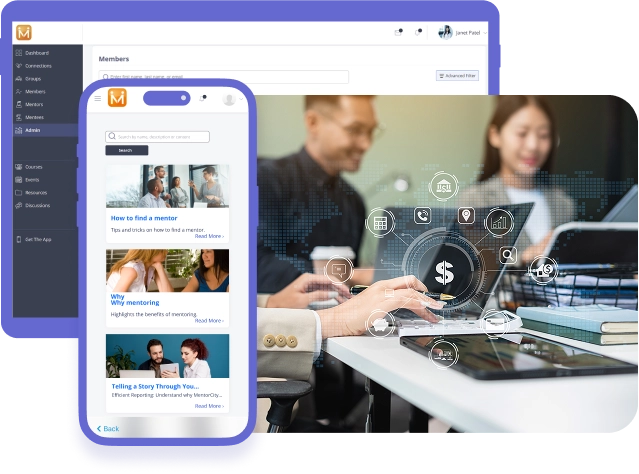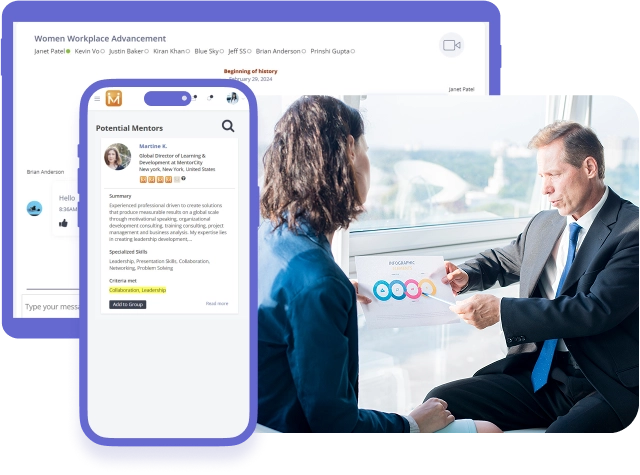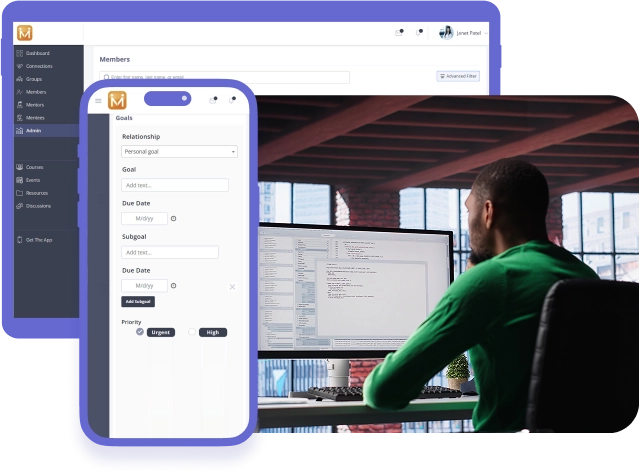

MentorCity is mentorship software with AI features that support the human relationship instead of replacing it. Lexa, our AI mentor, helps participants prepare and reflect between conversations, provides guidance and support to both mentees and mentors, and enables AI note-taking to keep each session focused. Both sit inside the same all-in-one platform program administrators already use to match participants, run programs, and prove impact, and administrators decide where AI fits and where it does not.
MentorCity is the mentoring platform that adds AI to support people, not to replace them. Lexa, our AI mentor, complements mentoring relationships, handles the in-between work: preparing for a meeting, reflecting afterward, and asking good questions to move people forward, it empowers them to come up with the answer on their own and practice skills, while the human mentor keeps the stories, encouragement, and lived experience.
More people are already turning to AI for career guidance, whether or not a program offers it. Research by The Conference Board found that 91% of people who used AI for career coaching said they would use it again, and 96% felt AI could provide customized coaching. People reach for it because it is available whenever they need it, and it can help them organize their thoughts, ask better questions, gather information, and look at a problem from different angles.
In many ways, AI fills some of the gaps between mentoring conversations. What it cannot do is sit with someone in a hard moment, or share what it was like to be in their shoes twenty years ago. As Fast Company reported, even as more workers look to AI for professional advice, they see the technology as supplemental to their human mentors, not a substitute for them.
What Is an AI Mentor? An AI mentor is a chat-based tool that complements a human mentor by providing guidance and support. It asks good questions, works through challenges people are experiencing, and helps people to practice skills, and it also helps prepare for a meeting and reflect afterward. In MentorCity, that is Lexa, available any time to keep momentum between sessions, while the human mentor keeps the lived experience, lessons learned, and shares stories that AI cannot provide.
AI Versus Human Mentoring. AI and human mentoring do different jobs, and the strongest programs use both. AI is available any time and is good for preparing, practicing, reflecting, and as a sounding board for thinking a decision through. The Conference Board found 91% of people who used AI for career coaching would use it again, and 96% felt it could give customized coaching. A human mentor brings lived experience, encouragement, and the judgment to sit with someone in a hard moment. MentorCity is built so AI handles the in-between work and people stay at the centre.
Meet Lexa, MentorCity's AI Mentor. Lexa is an AI mentor that lives in a chat window inside MentorCity. Participants can talk to Lexa whenever they want, and she responds with thoughtful questions that help them work through a decision, prepare for a meeting, or reflect on a recent conversation. Lexa is not designed to replace human mentors. She is designed to support participants between their mentoring conversations.
AI Notetaking That Keeps Sessions Focused. MentorCity also includes AI notetaking inside its integrated video conferencing. When mentors and mentees meet over video on the platform, AI notetaking helps capture the conversation so participants can stay present instead of scribbling notes. It is a small thing that protects the most valuable part of any program: the time two people spend actually talking.
Together, Lexa and AI notetaking are the AI features in MentorCity today, with more coming soon. They support the human relationship at both ends, before and after the conversation, without trying to automate the conversation itself.
Lexa and AI notetaking are useful because they live inside a full mentoring platform, not as a standalone chatbot. MentorCity gives program administrators everything they need to launch, run, scale, and measure a mentoring program in one place, with the AI features layered on top of relationships that are already structured and supported.
The platform includes:
Because everything lives in one platform, the AI features have real context to work with, and administrators are not stitching a separate AI tool onto a program that runs somewhere else.
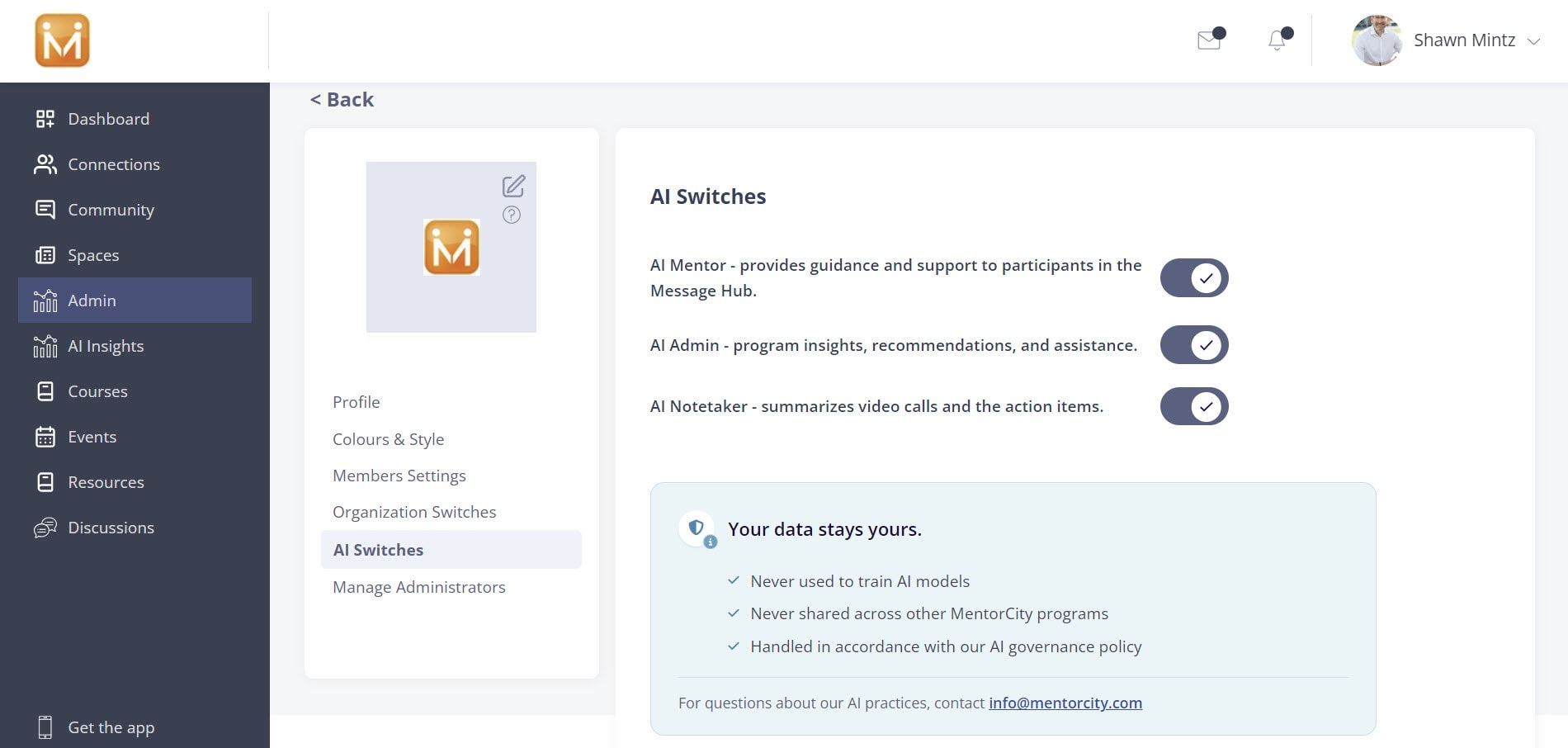
You decide where AI fits in your program, and where it does not. Lexa can be enabled under Organizational Settings for any program that wants to offer this kind of support alongside human mentoring. Programs that prefer to keep things fully human can leave her off. The choice sits with the program owner, not the software.
This matters because mentoring programs are not all the same. An onboarding program for new hires, a leadership cohort, an alumni network, and a public-sector initiative each have different needs. Giving administrators a simple switch means you can offer AI-assisted reflection, guidance, and preparation where it helps, and reserve human time for the moments that call for a person.
MentorCity’s AI-powered mentoring software uses intelligent matching algorithms to connect mentors and mentees based on skills, experience, career goals, personality traits, and individual preferences. This helps create compatible, productive mentoring relationships that improve engagement and program outcomes.
Administrators retain full control and can review or manually adjust matches, set custom matching criteria, and create group mentoring circles aligned with specific organizational objectives.
Every organization has unique mentoring needs.
MentorCity’s AI-powered mentoring software supports a wide range of program structures, from short-term onboarding and peer mentoring to ongoing leadership and career development initiatives.
The platform’s flexible configuration and AI-driven matching capabilities allow organizations to run multiple programs simultaneously, each tailored to specific teams, departments, locations, or development goals.
MentorCity’s AI-powered mentoring software provides detailed analytics on program participation, engagement, session frequency, user feedback, and other key performance indicators.
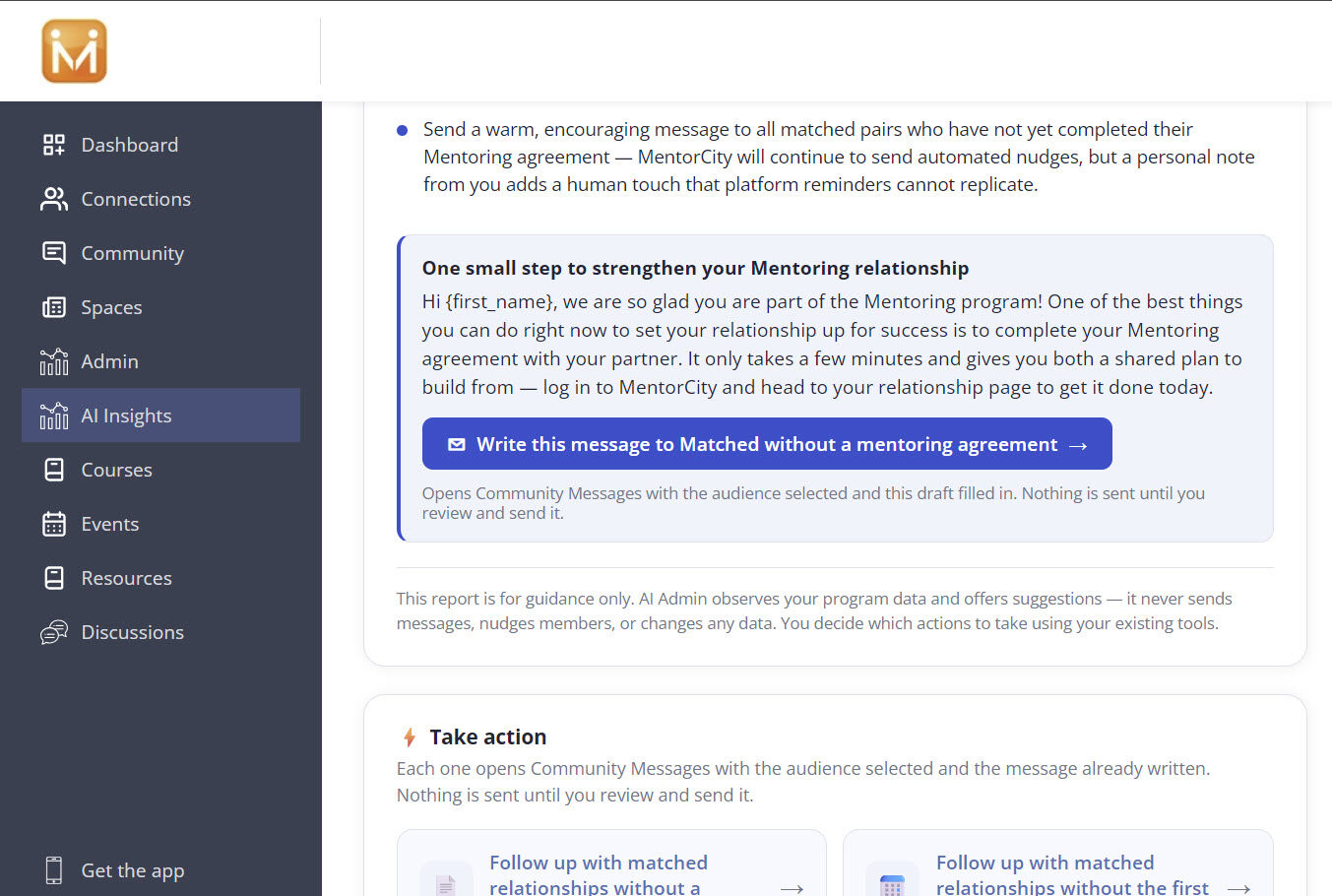
AI-driven insights help program managers identify trends, measure program impact and ROI, and make informed improvements that strengthen mentoring outcomes over time.
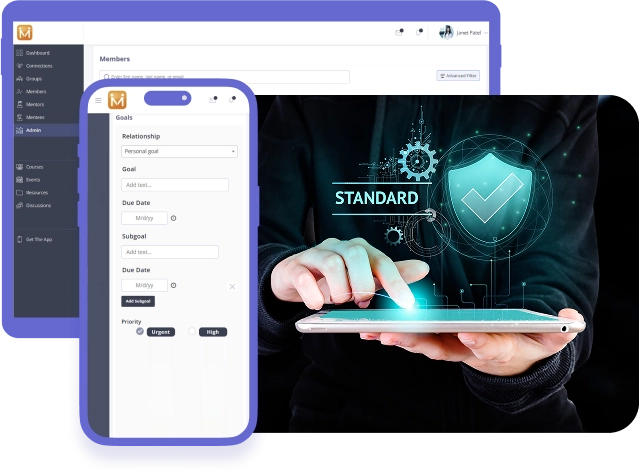
MentorCity’s AI-powered mentoring software is built with robust security protocols to protect sensitive user and organizational data. The platform supports multi-factor authentication, encrypted data transmission, and compliance with industry standards, enabling organizations to use AI-driven mentor matching, recommendations, and program insights while maintaining confidentiality and data integrity.
When you compare mentorship software with AI features, ask five questions:
MentorCity is built to answer yes on the human-control questions and to show its proof.
Organizations choose MentorCity because it turns mentoring into a structured, measurable program without the administrative burden that usually comes with it, and because its AI features are designed to protect human connection rather than dilute it.
The results show up in real programs:
MentorCity has been helping organizations run mentoring programs since 2011. Participant data is hosted in a SOC 2 Type II audited data centre in Canada, protected with 256-bit SSL, with daily backups. The platform scales from small pilot initiatives to programs with tens of thousands of participants, and supports associations, non-profits, government, enterprises, and education networks alike.
AI is changing how people seek guidance, and it will keep doing so. The organizations that handle it well will not be the ones that automate mentoring away. They will be the ones that use AI to support the human relationship: to help participants prepare, reflect, and find their own answers, so that human mentors can focus on the wisdom, stories, and connection that only people can provide.
That is the thinking behind every AI feature in MentorCity, the all-in-one mentorship software with AI features that helps organizations run, scale, and measure human mentoring while making it more accessible. If you want to see how Lexa and the rest of the platform could work for your programs, we would be glad to show you.
100+
Satisfied Customers
4.7 out of 5 in customer reviews
from Capterra, GetApp
Book a Demo Today.
MentorCity currently offers two AI features. The first is Lexa, an AI mentor that lives in a chat window and supports participants between their mentoring conversations by helping them prepare, reflect, and work through questions. The second is AI notetaking inside the platform's integrated video conferencing, which captures session conversations so participants can stay present. Both are built to support human mentoring relationships, not replace them.
No. Lexa is designed to support participants between conversations, not to take the place of a human mentor. She helps with preparation, reflection, and thinking through decisions, while the human parts of mentoring, the lived experience, stories, encouragement, and connection, stay with people. MentorCity sees AI and human mentoring as complementary, with human connection kept at the centre of every program.
Lexa helps participants prepare for upcoming mentoring meetings, reflect on conversations, and discover their own answers through thoughtful questions rather than prescriptive advice. Because she is available at any time, she helps participants keep momentum in the stretches between scheduled sessions, which is often where mentoring relationships lose steam.
Step 1: A participant prepares with Lexa, setting an agenda and thinking through what to ask.
Step 2: They meet a human mentor over the platform's integrated video, where AI notetaking captures the conversation so both stay present.
Step 3: They reflect with Lexa afterward and decide what to act on next.
Step 4: Administrators keep control, switching Lexa on or off per program and per feature.
Lexa and AI notetaking are part of the MentorCity platform, and program administrators enable Lexa under Organizational Settings for the programs that want it. Because packaging varies by program size and needs, the clearest path is a short pricing conversation. See the pricing page for how MentorCity's Standard and Enterprise plans compare, or book a demo and we will walk through what your program would include.
They do different jobs, and the strongest programs use both. An AI mentor like Lexa is available at any hour and is good for preparing, practicing, reflecting, and thinking a decision through. A human mentor brings lived experience, encouragement, and the judgment to sit with someone in a hard moment, which AI cannot do. MentorCity is built so AI handles the in-between work and people stay at the centre.
No, and MentorCity is not built to try. Some conversations are deeply personal. Lexa is designed to listen and ask good questions, while your human mentor brings the lived experience and trust built over time that makes those conversations meaningful. MentorCity uses AI to support the relationship and keeps people responsible for the mentoring itself.
Evidence says AI coaching helps for everyday guidance and is popular with the people who try it. The Conference Board found that 91% of people who used AI for career coaching would use it again and 96% felt it could give customized coaching. Some conversations are deeply personal. Lexa is designed to listen and ask good questions, while your human mentor brings the lived experience and trust built over time that makes those conversations meaningful. That is why MentorCity uses AI for preparation and reflection and keeps people at the centre of the relationship.
Use an AI mentor chatbot for the in-between work, not to replace mentors. It is well suited to helping employees prepare for a mentoring meeting, reflect afterward, and think a decision through at any hour. Keep humans responsible for the relationship, and keep control in the program owner's hands. In MentorCity, administrators switch the AI mentor on or off per program under Organizational Settings, so HR decides exactly where the chatbot helps.
AI notetaking runs inside MentorCity's integrated video so participants can stay present instead of writing notes. It operates within the same platform and the same security model as the rest of your program, with participant data hosted in a SOC 2 Type II audited data centre in Canada, protected with 256-bit SSL, with daily backups. Administrators decide which programs use the AI features, so you control where notetaking is turned on, and participants can opt in to having the notetaker turned on per call.
Yes. MentorCity is built to integrate with your existing IT systems, including single sign-on (SSO), and its AI notetaking runs inside the platform's integrated video conferencing. That keeps your identity and collaboration tools connected to the same place the AI features live, so IT maintains one security model. See the MentorCity integrations page for the current list, or ask during a demo.
Lexa can be enabled under Organizational Settings for any program that wants to offer AI-assisted support alongside human mentoring. The control sits with the program owner, so administrators can switch it on for the programs where it helps and leave it off where they prefer a fully human experience.
Yes. MentorCity hosts participant data in a SOC 2 Type II audited data centre in Canada, protected with 256-bit SSL encryption and daily backups. The AI features operate inside the same platform and the same security model as the rest of your mentoring program. MentorCity’s AI isn’t used to train AI models and isn’t shared across organizations.